
Technology along is not enough!
Many breakthrough technologies do not stall because the science is weak. They stall because the path to customers is still too unclear.
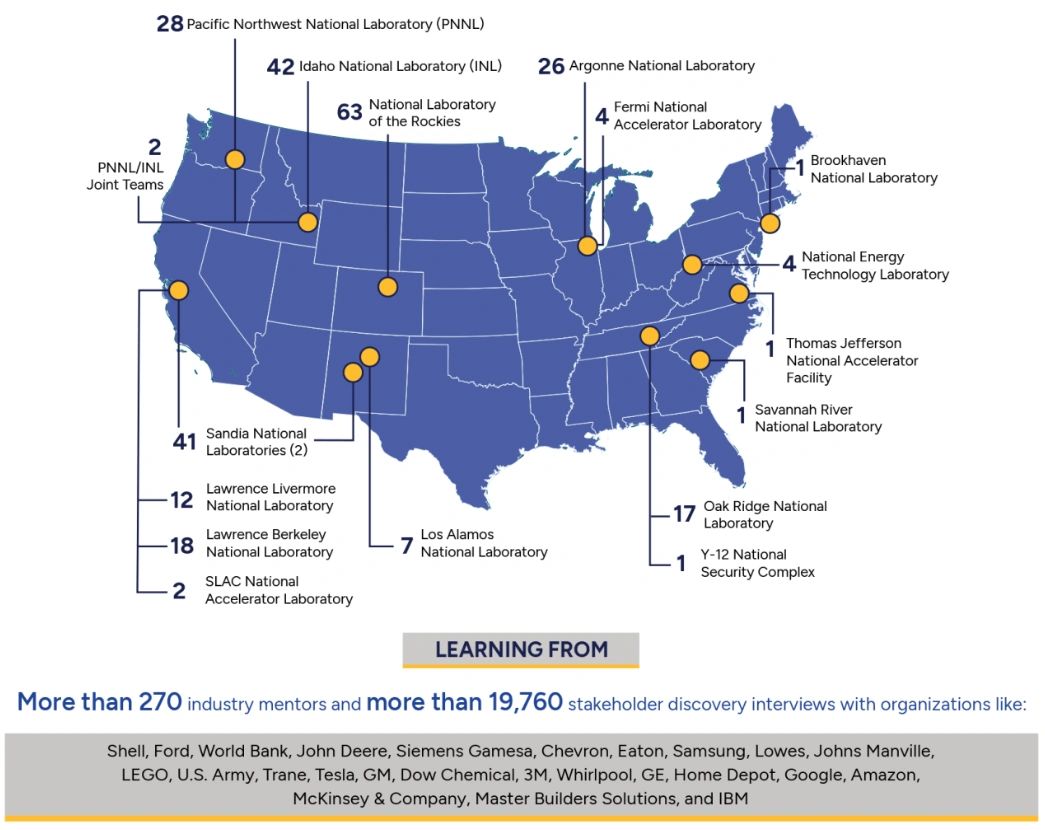
Last night I joined the kickoff for @DOE / U.S. Department of Energy’s Energy I-Corps program as an industry mentor to several teams of scientists working to bring breakthrough innovations to market. Incredible work – congrats Katie Woslager and team!
The room was full of brilliant researchers and scientific innovators from across the national lab ecosystem: @Ames Laboratory, @Argonne National Laboratory, @Idaho National Laboratory, @Lawrence Berkeley National Laboratory, @Lawrence Livermore National Laboratory, @Los Alamos National Laboratory, @National Energy Technology Laboratory, @National Laboratory of the Rockies, @Oak Ridge National Laboratory, @Pacific Northwest National Laboratory, and @Sandia National Laboratories.
I met with teams working on new approaches for complex, multi-decade super-project execution, physical AI systems that can create new HVAC efficiencies, and electrical grid transmission systems designed to eliminate wasted electric capacity.
The science and technology were impressive. The commercial questions were just as important – that is what stood out to me most.
Commercial Strategy
At Banimo, I spend a lot of time helping companies think more clearly about growth through partnerships. In settings like this, that usually starts with one discipline that deserves much more attention:
Building and maintaining a Partner Market Map
When people hear “partner strategy,” they often think too narrowly — channel partners, resellers, or some sort of “alliances.”
But for companies bringing new technology to market, partner strategy is much bigger than that.
It is about understanding the full ecosystem required to:
- access customers,
- implement effectively,
- reduce adoption friction,
- and make customers successful over time.
That means getting clear on the jobs partners may perform.
- Who shapes demand?
- Who validates the solution?
- Who sells?
- Who integrates?
- Who installs?
- Who finances?
- Who services?
- Who supports long-term success?
These are not secondary questions. They are central commercialization questions.
In energy, climate, industrial systems, and other infrastructure-heavy markets, customers rarely buy innovation in a straight line. They buy outcomes that depend on trust, implementation capacity, operating fit, and long-term support. Partners are often the bridge between invention and adoption.
That is why partner motions should not sit on the edge of commercialization strategy. They need to be at the center of it.
A strong partner market map helps a team answer critical questions early:
- Who actually influences adoption?
- Which partner roles are mission-critical?
- Where does the customer journey break without ecosystem support?
- What kind of commercial system has to exist for this innovation to scale?
This is also why I believe so strongly in defining partner jobs.
The Customer / Partner Journey
A partner is not just a category. A partner is a function in the customer journey.
Once teams get precise about those jobs, their commercialization strategy gets sharper, their go-to-market model gets more realistic, and their path to scale becomes easier to see.
The teams I met last night are working on important problems with enormous economic and societal significance.
One of the most valuable things they can do now is not just refine the technology or even the value proposition.
It is to build a living view of the ecosystem around the business — and get rigorous about who helps them reach customers, who helps customers succeed, and what must be true for adoption to happen at scale.
Don’t forget, the companies that win are not always the ones with the most impressive technology. They are often the ones with the clearest path from innovation to market.
Brett Simpson Arun Veeramany Qinghui Shao Clint Frye Jacob Leach Tianzhen Hong Chun-cheng Piao Han Li
#commercialization #partnerships #energy #innovation #gotomarket #alliances #climatetech #deeptech #Banimo #sustainability