
Optimizing Existing Partnerships: A Revenue Acceleration Playbook

For mature software and saas companies—over the $50M ARR threashold—the conversation around growth with partnerships often starts with new logos: the next reseller, the next integration partner, the next strategic alliance. But in organizations with established ecosystems, the real opportunity (and the harder challenge) lies in extracting full value from existing partnerships.
Too often, high-potential partnerships plateau—revenue contribution flattens, engagement declines, and the relationship shifts to maintenance mode. In the eyes of investors and GTM leadership, this is not just a missed opportunity—it’s a drag on enterprise value and a sign of a stagnating asset.
Why Mature Companies Struggle with Partnership Optimization
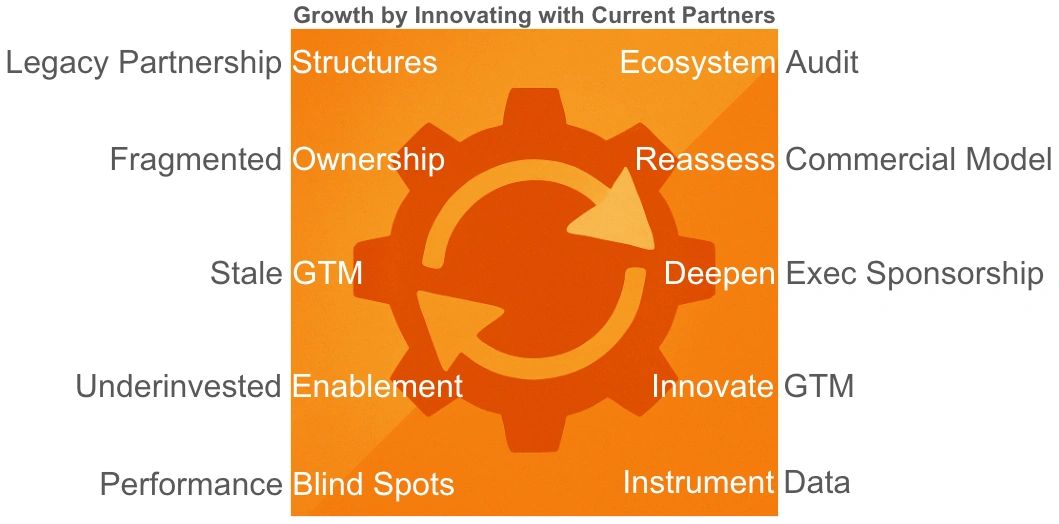
1. Legacy Relationship Structures
Partnership terms, pricing, and go-to-market commitments often reflect market conditions from years ago. These agreements can lock both parties into outdated motions that no longer fit current buyer behaviors or competitive realities.
2. Fragmented Ownership
Over time, multiple internal teams may have touched the partnership—sales, marketing, alliances, product—but without a single accountable owner for performance, governance becomes reactive rather than proactive.
3. Stale GTM
Partners evolve just like your company. What was once a perfect fit for their sales motion may no longer be relevant. Without periodic re-alignment, even strong partners can deprioritize your offering in favor of higher-margin or faster-moving alternatives.
4. Underinvestment in Enablement
Initial onboarding and enablement often happen once—at launch. Without continuous refreshes of messaging, playbooks, and joint marketing, seller-level knowledge erodes and pipeline suffers.
5. Performance Blind Spots
Many companies track partner revenue but lack the diagnostic metrics to know why performance is trending up or down—activity metrics, deal registration, pipeline coverage, conversion rates, or attach rates to the partner’s own offerings.
The Path to Optimization
For CROs, investors, and senior GTM leaders, partnership optimization is not about “managing” existing partners—it’s about reengineering them for maximum value.
1. Audit and Segment the Portfolio
Evaluate all active partners by performance potential, profitability, and strategic fit—not just historical revenue. Many mature companies find 20–30% of their partners generate 80% of the value. Focus optimization efforts there first.
2. Reassess the Commercial Model
Consider refreshing MDF allocations, incentive structures, margin profiles, and other key high-value terms to better align with current GTM goals (for you and the partners). For example, moving from volume-based incentives to value-based incentives can reignite partner focus.
3. Deepen Executive-to-Executive Alignment
Annual reviews aren’t enough. Refresh executive sponsorships and establish quarterly, high-level checkpoints between your leadership and theirs to discuss joint market strategy, competitive positioning, and innovation opportunities.
4. Build a Fresh Partner-Specific GTM Plan
Move beyond generic channel marketing. Design a plan with joint value propositions, co-selling motions, pipeline generation tactics, and enablement paths bespoke to key strategic partner’s business model and customer segments. And importantly, refresh with your own teams to be sure partner coverage, practices and inspection are engaged and active.
5. Instrument with Data
Set up dashboards that track not only revenue, but also leading indicators: partner-sourced pipeline, average sales cycle time, win rate, attach rate, and partner engagement scores. Use these to adjust tactics mid-quarter, not post-mortem. The span of rewards and recognition tied to performance can also ensure individuals are motivated and a culture of over-performance is fostered.
The Investor and CRO Lens
For investors, underperforming partnerships are a fixable, near-term lever for value creation. Unlike net-new partner acquisition, which takes quarters or years to mature, optimization efforts on existing partnerships can deliver revenue lift within a single fiscal period.
For CROs, the message is clear:
- Partnership optimization is not a “side project”—it’s a revenue acceleration initiative.
- The right interventions—executive alignment, commercial model refresh, targeted enablement, and data-driven management—can turn flat-line partnerships into double-digit growth drivers.
Bottom line:
Your existing partnerships are often your most undervalued growth asset. Optimizing them requires a shift from relationship maintenance to performance engineering—a discipline that, when done right, delivers a measurable impact on both top-line revenue and enterprise valuation.