
Partner Strategy 101: Setting Up for Success

This week we’re taking a look at the foundational elements needed for effective partner strategies
I see young innovative companies plowing into partnerships from two perspectives:
1) The early-stage company aiming at traction with established companies that have desirable clients, and
2) The established company that has a large volume of smaller, earlier stage potential partners to expand value for clients
From both points of view, partnerships can be a major growth lever—unlocking new customer access, accelerating pipeline, introducing new revenue streams, and expanding delivery capabilities. But too often, companies jump into partner engagements without the fundamentals in place. The result? Missed revenue, underperforming relationships, and wasted resources.
Whether you’re launching your first partner program or strengthening an existing one, or if you’re on the receiving end of a large fragmented ecosystem, the right foundation is critical.
Here’s a framework that improves outcomes:
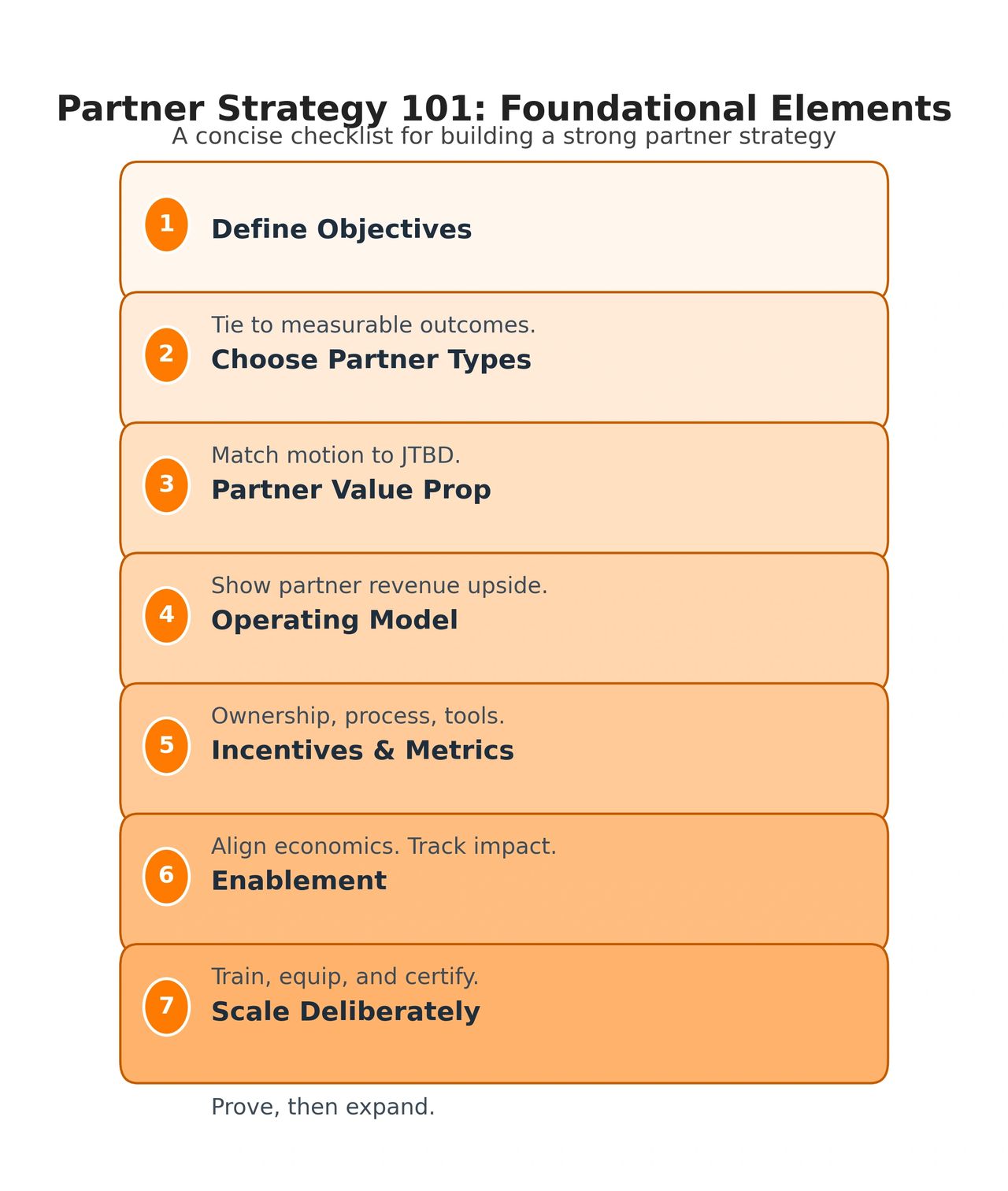
1. Define Clear Business Objectives
Start with specific, measurable business outcomes tied to your corporate strategy:
Revenue growth: Direct or influenced pipeline, bookings, and ACV expansion.
Market access: New segments, geographies, or industries.
Capability expansion: Complementary services, integrations, or IP.
Without clarity on “why,” you risk chasing the wrong partners or diluting focus.
2. Select the Right Partner Types
Different partner models deliver different value. Early-stage companies may need focus; more mature companies may expand into multiple partner motions:
Referral Partners: Generate leads and influence deals.
Resellers / Distributors: Drive end-to-end sales and delivery.
Service / Integration Partners: Increase product adoption and stickiness.
OEM / Embedded Partners: Monetize IP at scale.
Strategic Alliances: Joint solutions with high impact potential.
Align partner type to the business “job to be done,” not just to market availability.
3. Build a Compelling Partner Value Proposition
Partners need to see the upside for their business, not just yours. Your partner value prop should clearly answer:
How will this partnership help them win more deals or grow revenue?
What competitive advantage does your solution offer?
How will you enable and support their success?
How do clients get more value from a combined solution/team/service?
A strong value prop makes recruiting and activating partners easier and faster.
4. Establish an Operating Model
Your operating model is the engine that turns intent into results:
Ownership: Clear internal accountability for partner success (and cross-functional engagement beyond the partner team).
Processes: Standard onboarding, enablement, and joint business planning. Also a clear/easy MDF/PDF management process.
Tools: Partner relationship management (PRM), shared CRM, reporting, and deal registration.
Even small programs need a defined cadence and structure—without it, performance will stall.
5. Align Incentives and Measurement
The fastest way to lose partner momentum is misaligned economics or opaque results.
Incentives: Margin structures, referral fees, or joint marketing funds that make the partner’s investment worthwhile – not just at the org level, but down to the seller level if possible.
Metrics: Pipeline contribution, win rate, deal cycle time, Average ARR, partner-sourced vs. influenced revenue. The list is long, so start with these.
Transparency: Regular reporting so both sides can transparently track impact and course-correct.
6. Prioritize Enablement from Day One
Enablement isn’t a one-time onboarding—it’s an ongoing practice. Equip partners with:
Sales and marketing assets tailored for their audience.
Product training and demo environments.
Competitive positioning and objection handling.
The more confident your partners are, and the easier you are to work with, the more likely they are to lead with your solution.
7. Start Small, Scale Deliberately
Resist the temptation to recruit dozens of partners at once. Prove your model with a focused set of high-potential relationships, then scale based on what works. This prevents chaos and ensures learnings shape your expansion. At least start with a narrow focus on a single category of partners to test, iterate and improve before expanding.
Special Consideration: If you’re running a marketplace or other broad, cross-category ecosystem for a mature partner organization, you’re wasting your time unless you take into account the maturity (or lack thereof) of the partners you want to play in your marketplace/ecosystem. If you can’t facilitate transactions for your ecosystem, they’ll get frustrated and likely will end up frustrating you or others in your organization.
Bottom line: A successful partner strategy is built methodically. By defining your “why,” selecting the right partner types, crafting a clear value proposition, establishing an operating model, aligning incentives, and prioritizing enablement—you set the stage for sustainable growth.