
Innovation x (Product + Partnership) = Sustained Growth

This week’s Nobel Prize in Economics went to Joel Mokyr, Philippe Aghion, and Peter Howitt — three economists whose work has profoundly shaped how we understand innovation and long-term economic growth.
Their research explains that growth isn’t simply about invention — it’s about the diffusion of innovation through interconnected systems. Progress happens when new knowledge is transformed into productivity across firms, industries, and societies. It’s a cycle: new ideas drive growth, growth creates demand for more ideas, and institutions and partnerships sustain the cycle.
That idea — innovation as a networked phenomenon — resonates deeply with the work I do today.
Case #1: From the Lab to the Market: Innovation Needs Ecosystems
By way of example, at last weekend’s finale to the Colorado Sustainability Challenge, where student teams presented breakthrough ideas for a more sustainable world, I saw this economic theory play out in real time.
Dozens of student ventures showcased remarkable ingenuity — technologies for biochar, distributed AI compute/energy, new compostable packaging for CPG, and A/C efficiency enhancement amongst others. But what separated the feasible from the fantastic wasn’t just the novelty of the idea; it was the ability to connect that idea into a broader ecosystem that supported widespread adoption.
Whether it’s a new phase change material embedded in-line with commercial A/C systems, or an agriculture innovation that depends on logistics partners, every great idea needs pathways into existing systems to scale. Innovation may start in a lab or classroom, but adoption happens in the ecosystem.
Case #2: The Same Pattern in SaaS and AI
In this second example, I see this same pattern in the start-ups and growth-stage companies I work with every day.
The most forward-thinking founders aren’t just building new products; they’re building new partner models in parallel. They understand that innovation doesn’t reach full potential until it connects — commercially, operationally, and strategically — with other players in the market.
Across AI and SaaS companies, this looks like:
- Joint IP creation — where product innovation and partner motions combine into unique, high-value offerings.
- Shared economic models — moving beyond traditional referral or reseller frameworks into co-investment, co-delivery, and data-driven value where revenue is more deeply intertwined with joint GTM execution.
- Ecosystem-driven adoption — aligning new capabilities with the distribution and credibility of trusted partners to drive substantial market traction.
When companies innovate their partner model in sync with their product roadmap, they multiply the impact of both.
Matching Product Innovation with Partner Innovation
It’s easy to celebrate the breakthrough product launch or the next-gen platform announcement. But what often goes unseen — and underinvested — is the innovation that needs to happen around the product:
- new partner enablement motions
- revised incentive structures
- shared customer success practices
- and integrated sales and marketing execution that positions the innovation for easier large-scale adoption
Without those, innovation risks becoming a brilliant but disconnected idea.
The companies winning today — especially in fast-evolving domains like AI, cybersecurity, and work tech — are the ones that build partner innovation into their operating motions. They treat partnership not as a distribution mechanism, but as a growth multiplier – expanding the surface area that supports larger-scale adoption and remarkable customer experiences.
A Framework for Creating Sustained Growth
Drawing from both economic theory and practical experience, the formula for sustained innovation looks like this:
Innovation × Partnerships = Sustained Growth
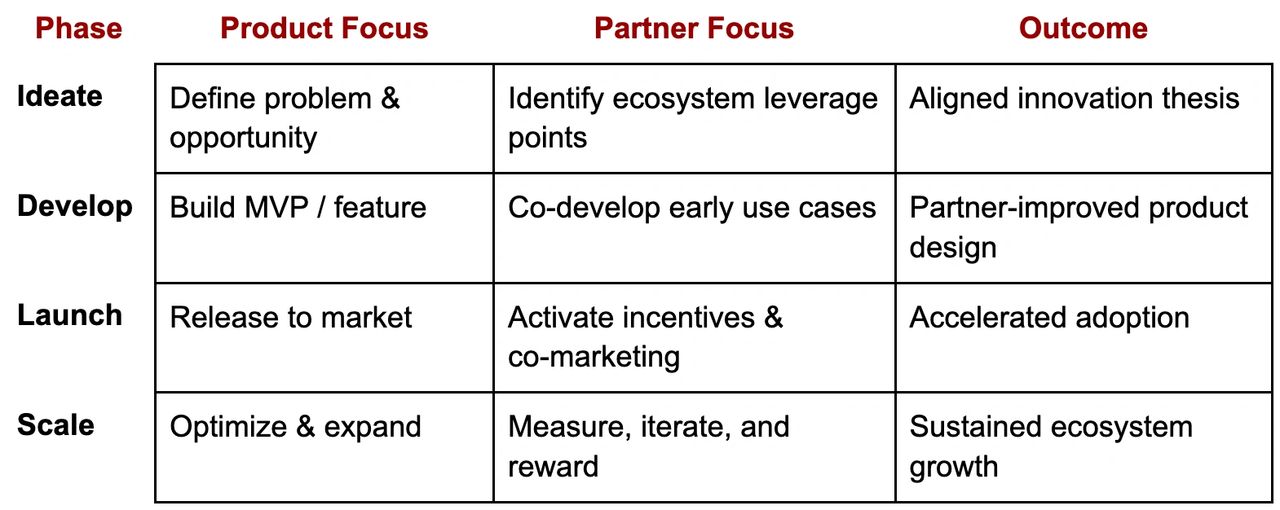
It’s the same growth engine that the Nobel committee recognized: innovation sustains itself through connection.
Closing Thought
The work of Mokyr, Aghion, and Howitt reminds us that innovation doesn’t exist in a vacuum. Sustained progress happens when creativity meets collaboration — when great ideas find fertile ground in the systems, networks, and relationships that make them real.
From the Colorado Sustainability Challenge to software companies building the next wave of AI-driven solutions, the challenge is the same:
Match your solution innovation with partner model innovation.
That’s how new ideas become movements — and how ecosystems, not just individual companies, create lasting growth.
At Banimo, we’re helping companies do exactly that: align solution design, partner strategy, and execution to accelerate growth through innovation ecosystems. And it’s some of the most exciting work happening in tech today.