
Treating Partners as an Afterthought? Your Competitors Aren’t!
A practical guide to building a partner ecosystem that actually drives revenue
Early-stage, funded tech companies are under real pressure to establish and refine
product-market fit. And while that work is consuming, the companies that build enduring
GTM traction are the ones that also invest, early, in developing partner-market fit. A
thoughtfully designed partner ecosystem isn’t a vanity asset. It’s the infrastructure that
allows your IP to scale beyond what your direct sales team can reach on its own.
I get it. In the early days, partnerships rarely make the top of the priority list. You’re
hiring, closing your first customers, figuring out the product. There’s simply no slack in
the system. Partnerships feel like a “when we have more capacity” conversation. But
here’s what I’ve seen repeatedly, across companies of all sizes: the window to lock in
the right strategic alliances is shorter than most realize, and the cost of waiting is
usually measured in pipeline you never built.
The good news is you don’t need a full partner team or a complex program to start. You
need a plan. Here are the five components I walk every client through.
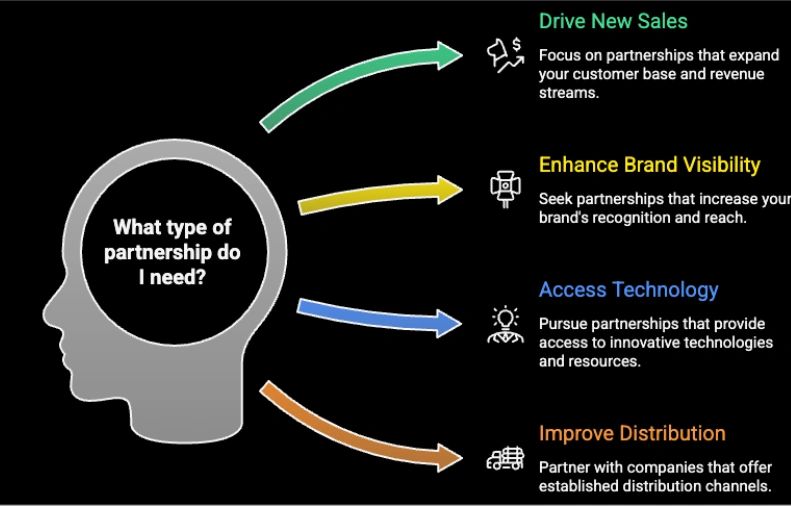
1. Define the Type of Partnership You Need
Not all partnerships serve the same purpose, and trying to pursue all of them at once is
one of the fastest ways to dilute your effort and budget. Are you trying to drive net-new
sales? Expand brand credibility in a new market? Access technology or distribution you
don’t have in-house? Each requires a different type of partner and a different level of
investment.
Early-stage companies should resist saying “yes” to every inbound partnership
conversation. Get clear on the gap you’re filling and pursue the partner type that
addresses it most directly.
2. Prioritize Ruthlessly and Allocate Resources Accordingly
Once you know what types of partnerships make sense, rank them. Which will deliver
the fastest time to value? Which are the longer-term strategic bets? Your time and
budget are finite, treat them that way.
In practice, this means building a tiered approach: develop one or two high-priority
relationships deeply, while keeping a broader pipeline of opportunistic partnerships
warm. This is how you build momentum without spreading yourself thin.
3. Agree on Shared KPIs Before You Start
This is the step most companies skip and it’s usually the one that causes partnership
failures down the road. You and your partner need to agree on what success looks like
before you start executing together.
This is especially important when you’re working with a partner who doesn’t have a
formal program, or when the value you’re delivering falls outside their standard metrics.
Define KPIs that capture your contribution: influenced pipeline, co-sell revenue, joint
customer wins and make sure they’re tracked and visible to both sides.
4. Build a Program and a Playbook That Match Your Maturity Level
Here’s a distinction I find useful in practice: your partner program is external-facing, and
your partner playbook is internal. Both matter, and both need to be calibrated to where
your company actually is today. Don’t let perfect be the enemy of functional.
The program, what you present to and commit to with your partners, defines the
structure of the relationship: what it is (co-sell, referral, technology integration), what
each party brings, and what the mutual expectations are. For the partners you’re
pursuing first, codify this into a clear, simple partner agreement. Nothing elaborate. Just
enough to align on terms and create accountability on both sides.
The playbook is your internal operating guide, and this is where real accountability lives.
Before you make commitments to a partner, every functional leader who will be affected
by that relationship needs to explicitly participate in defining — and agree to — those
commitments. Sales, product, marketing, customer success: they all need a seat at the
table. Partnerships fail internally before they fail externally, and it almost always comes
back to a leader who felt over-committed without being consulted.
As you grow, the playbook becomes the foundation for onboarding new team members
into the partner motion and scaling the program consistently across functions.
5. Assign Ownership and Keep It Moving
A partnership without clear internal ownership is just a conversation. Someone on your
side needs to be accountable for driving the relationship forward; tracking commitments,
managing the cadence, and escalating when something stalls.
Decide this before you finalize any partnership. Document the actions, the owners, and
the next-step dates. Even if you’re managing it from a spreadsheet right now, build that
habit. It’s much easier to scale a system than to retrofit one after the relationships are
already live.
Working Within Established Partner Programs
When you’re engaging with larger players: hyperscalers, major SIs, platforms with tiered
partner programs, their structure can feel like it does the work for you. It doesn’t. You
still need your own plan.
The partners who earn mindshare and co-sell support from the Amazons and Googles
of the world are the ones who show up with intentionality; clear goals, consistent
engagement, and measurable results. I’ve seen this firsthand.
When to Bring in Outside Help
If this feels like a lot given where you are right now or, you simply don’t have the
bandwidth to execute, don’t let that be the reason you delay. A fractional partnership
executive can help you build the foundation, identify the right partners, and develop a
go-to-market strategy without the overhead of a full-time hire.
The right advisor can compress your timeline significantly and help you avoid the
expensive missteps that slow most early-stage companies down, especially when it
comes to picking the right partners to pursue first.
The companies winning in their markets today aren’t doing it alone. They’re
building ecosystems intentionally, with the right partners, and earlier than you
might think. Start with a plan, get your internal team aligned, and the
compounding returns will follow.
About the Author
Vita Stramaglia is a Principal at Banimo, a strategic growth advisory firm, where she
specializes in partner ecosystem strategy, alliance development, and go-to-market
execution for early-stage and growth-stage technology companies. With over 10 years
of experience building and scaling partner programs at companies including KPMG,
IBM, Oracle, and Domo, Vita works with founders and CROs to design the partner
infrastructure that turns relationships into revenue.