
The Alliance Operating System
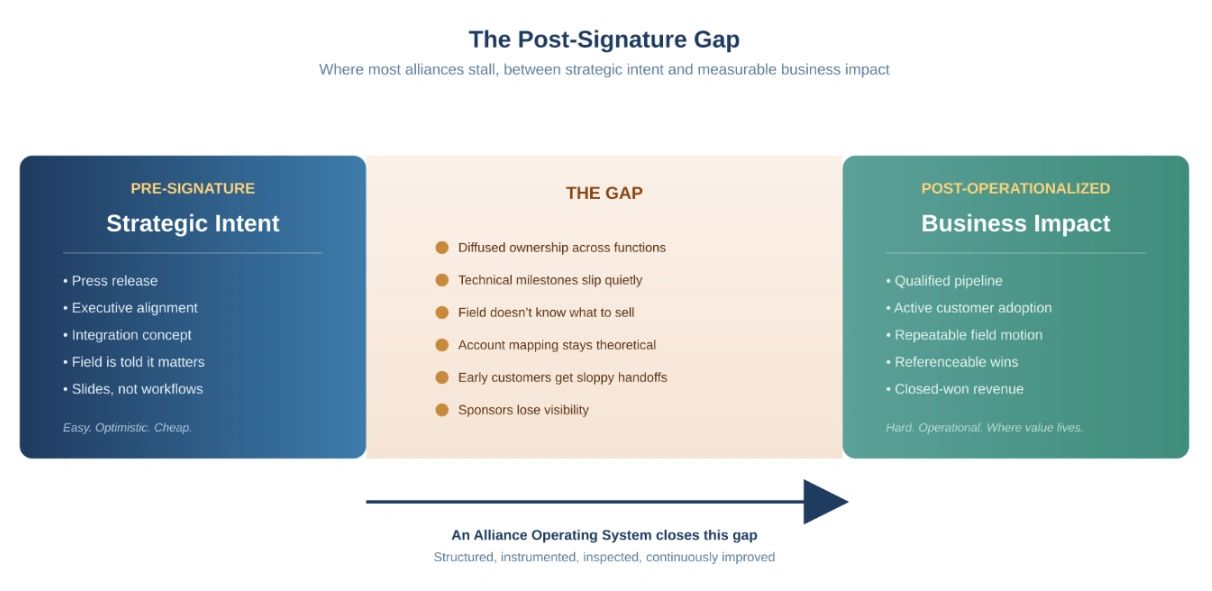
Why post-signature execution, not partnership intent, decides whether strategic alliances become revenue engines.
EXECUTIVE THESIS
Post-signature success is driven by speed to execution, not partner strategy alone. The alliances that win convert intent into pipeline, customer adoption, and repeatable field motion within the first 90 to 180 days. Everything else is a press release.
Most companies don’t fail at partnerships because they lack ambition. They fail because the partnership never becomes operational.
The press release goes out. Executives agree on strategic value. Product validates the integration concept. The field hears that a new alliance is important. And then execution gets fragmented across product, engineering, sales, customer success, services, and partner teams. Each function has its own priorities, cadences, and definitions of success.
That fragmentation is the post-signature gap: the space between alliance strategy and measurable business impact. Closing it takes more than relationship management. It takes an operating model.
I think of that model as an Alliance Operating System: a disciplined, cross-functional execution framework that turns strategic alliances into production-ready integrations, qualified pipeline, active customer usage, and scalable revenue motions.
Strategy is not the same as execution
A signed partner agreement is not a business outcome. It is permission to begin the hard work.
Strategic alliances stall after signature because ownership is diffused. Product owns the integration roadmap. Engineering owns delivery. Sales owns opportunities. Customer Success owns adoption. Partner teams own the relationship. No single operating layer connects those functions into one execution rhythm.
The pattern is predictable, and once you’ve seen it a few times you can spot it in the first 30 days:
- Technical milestones slip. Quietly, because no one owns the cross-team timeline.
- The field doesn’t know what to sell. The play is generic, the use cases are abstract.
- Account mapping stays theoretical. A spreadsheet exists. Nobody is acting on it.
- Early customers get a sloppy handoff. Nobody told CS the integration shipped.
- Executive sponsors lose visibility. By the time it surfaces in a QBR, the alliance is already underperforming.
None of this is dramatic. That’s why it’s dangerous. Alliances rarely die from one big problem. They erode from a dozen small ones the operating model never caught.
The Alliance Operating System: five programs that create execution velocity
A strong Alliance Operating System connects Product, Engineering, Sales, Customer Success, TAM, Services, and Partner teams into one repeatable model. The structure is built around five core programs.
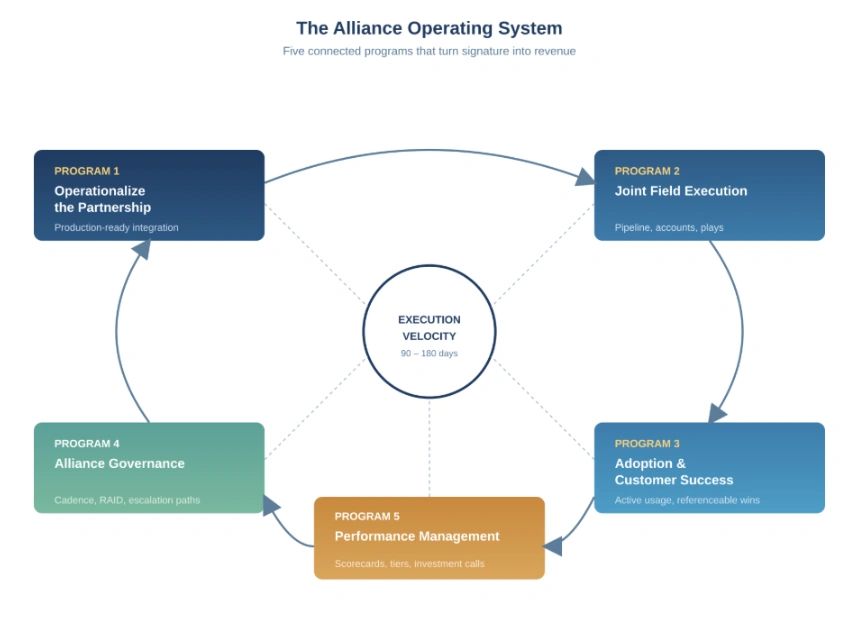
Figure 2. The Alliance Operating System cycle. Five programs, one execution rhythm.
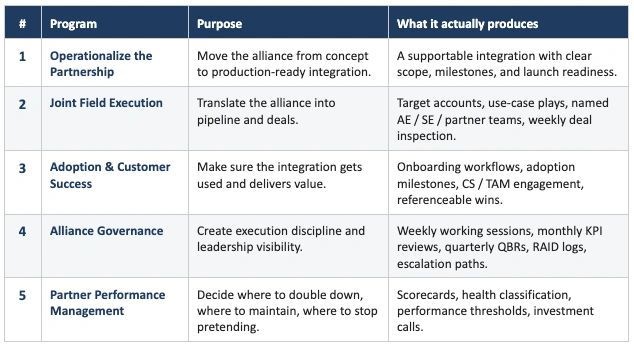
Program 1: Operationalize the partnership
The first job after signature is to convert the alliance into something the market can actually consume. That means defining the integration charter, technical scope, API dependencies, roadmap alignment, validation criteria, support model, and launch readiness checklist.
Most alliances lose momentum here. Teams assume the strategic intent is obvious, but execution depends on precision: what is being built, who owns each milestone, what blockers exist, and what has to be true before the field can sell with confidence.
The output is not a slide. It is a production-ready, supportable integration aligned to customer value and internal operating reality. If you can’t hand it to a frontline engineer and a frontline AE on the same day, it isn’t done.
Program 2: Turn the alliance into pipeline
The fastest way to prove a partnership is to get to the first qualified opportunity quickly. My bias is to secure the first deal signal within 45 days, then use that motion to build a repeatable co-sell play.
That starts with account mapping. Identify the top 20 to 50 accounts where customer problem, partner relevance, buying propensity, renewal timing, and field relationships actually intersect. Then define the specific use case the field should lead with. Not a generic partner message, but a practical wedge: competitive displacement, cloud migration acceleration, security modernization, cost takeout, risk reduction, or faster time to value.
Joint field execution requires named AE, SE, partner, and technical owners. It also requires weekly deal inspection, because partner pipeline doesn’t mature on its own. It atrophies.
Program 3: Adoption is the proof point
Closed-won revenue matters, but adoption is what makes the alliance durable. If the integration isn’t used, customers don’t realize value. If they don’t realize value, the field stops believing in the motion. If the field stops believing, the alliance becomes a relationship exercise, not a growth engine. That sequence is hard to reverse.
Which is why CS, TAM, and Services have to be in the room from day one. The team needs onboarding workflows, customer handoffs, adoption milestones, escalation paths, and a way to turn early wins into proof points the field can reuse.
Program 4: Governance creates speed
Governance gets a bad reputation as administrative overhead. In strong alliances, it’s the mechanism that creates speed. A disciplined cadence prevents issues from hiding in the seams between organizations.
The model should include weekly working sessions for blockers, weekly or biweekly pipeline reviews, monthly KPI reviews, and quarterly executive QBRs. A simple RAID log (risks, actions, issues, dependencies) gives leaders a common fact base. Escalation paths should be defined before they’re needed, especially for technical blockers, GTM misalignment, and customer adoption risks.
Cadence isn’t bureaucracy. It’s how cross-functional work stops being heroic and becomes routine.
Program 5: Measure, prioritize, scale
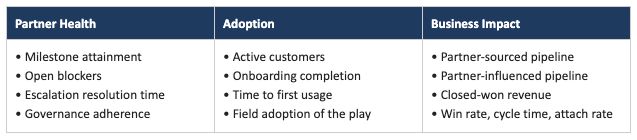
Not every alliance deserves the same level of investment. Performance management is how the organization decides where to double down, where to remediate, and where to maintain a lighter-touch model.
The scorecard should look across three dimensions: partner health, adoption, and business impact.
The 0–180 day roadmap
A practical operating system has to be time-bound. The first six months should move from foundation to activation to scale to optimization. You should be able to point to specific outputs at each phase.
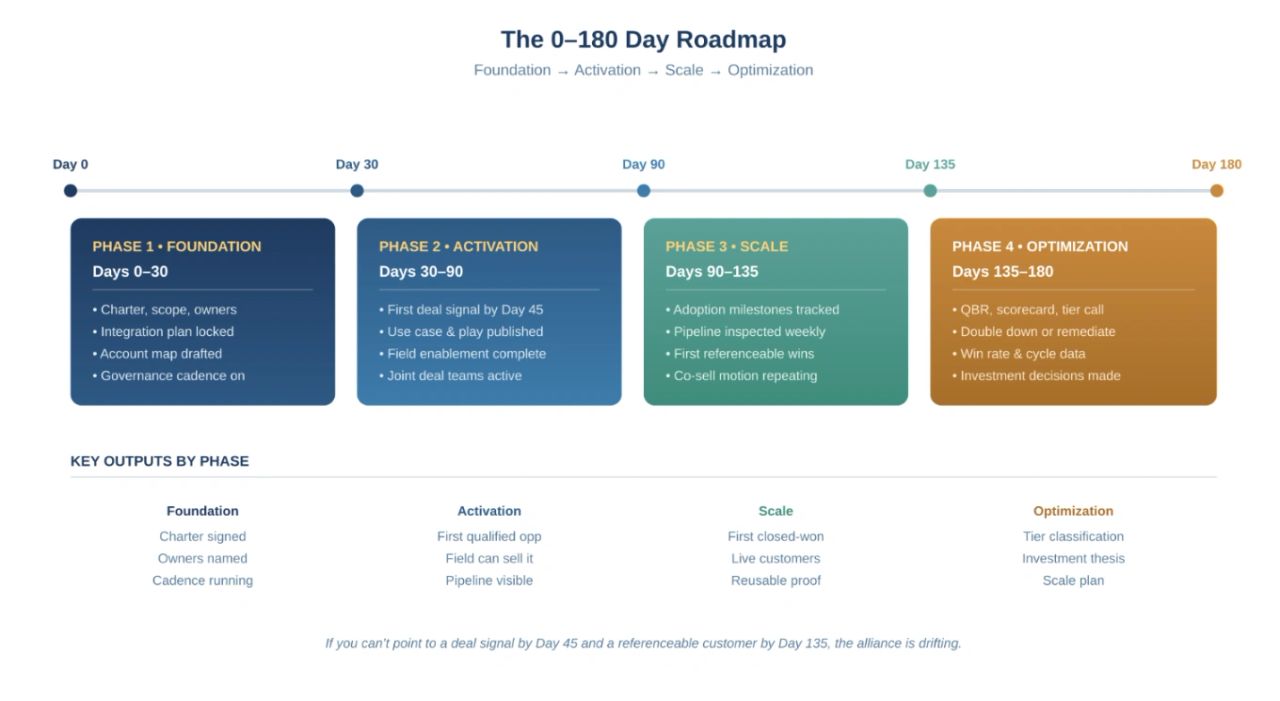
Figure 3. From foundation to optimization in 180 days. If you can’t point to a deal signal by Day 45 and a referenceable customer by Day 135, the alliance is drifting.
The dates are deliberately uncomfortable. They’re meant to force a conversation in week three rather than month three. If the team can’t commit to a Day 45 deal signal, the issue is rarely the partner. It’s usually that nobody owns the play, or the play doesn’t exist yet.
A simple prioritization model
The hardest operational decision in alliances is focus. Score each alliance against five criteria: revenue potential, customer overlap, integration complexity, field demand, and executive sponsorship. Then plot it against execution readiness.
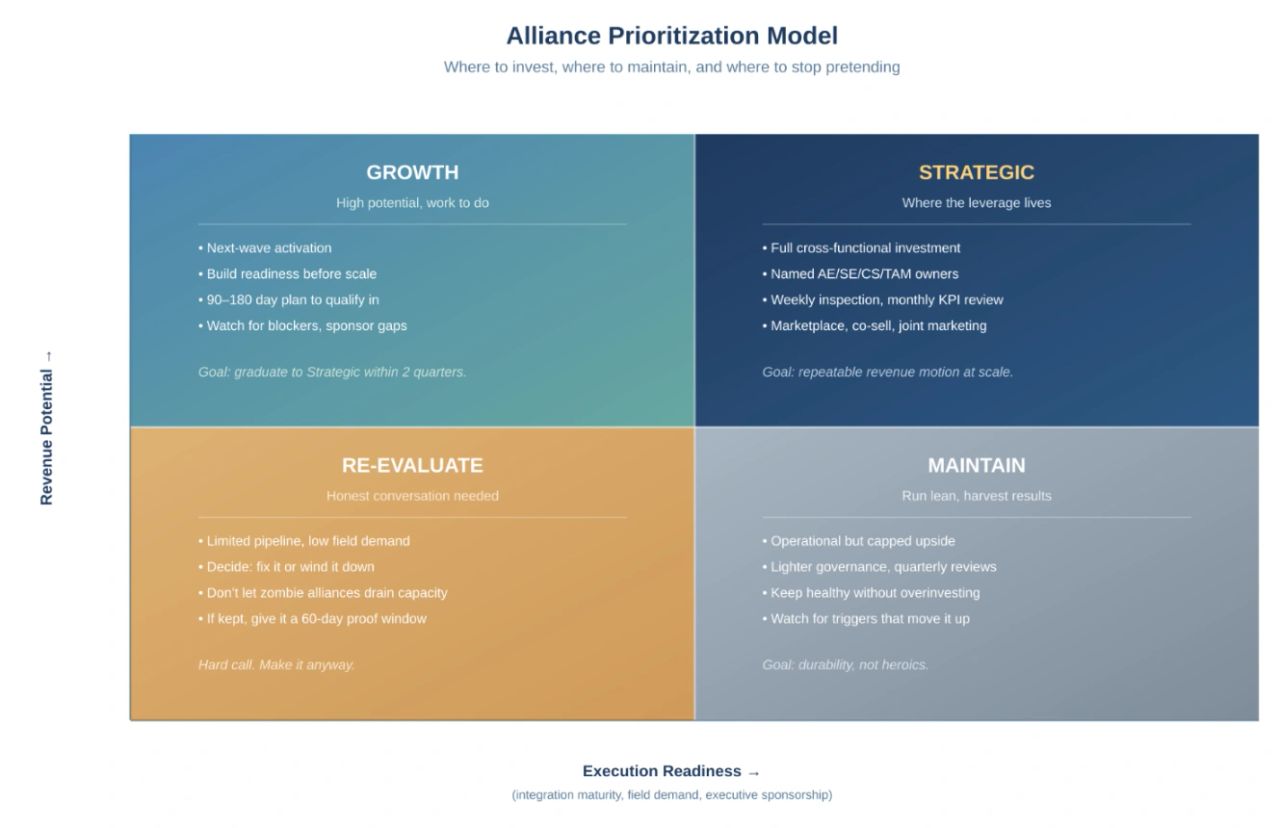
Figure 4. The prioritization model. Strategic alliances earn full investment. Re-evaluate is the quadrant most alliance leaders avoid. They shouldn’t.
Strategic alliances get immediate cross-functional investment. Growth alliances enter the next wave of activation with a 90–180 day plan to qualify in. Maintain alliances stay healthy on lighter-touch governance. The Re-evaluate quadrant is the one most alliance leaders quietly avoid, and the one that quietly drains the most operating capacity. Make the call.
EXECUTION SEQUENCE: Define the use case. Validate technical feasibility. Complete integration milestones. Enable internal teams. Launch the GTM motion. Measure adoption. Scale or remediate. Repeat with the next alliance.
What this looks like in practice
In cloud and software ecosystems, this model has more leverage than most because the partner motion has to connect product value, marketplace procurement, field execution, and customer adoption. A strong alliance leader has to be part strategist, part operator, part revenue driver, and willing to argue with all three when they don’t agree.
In AWS co-sell environments, the operating system starts with propensity signals and account mapping, narrows to priority customers, defines the use case, enables the field, builds joint deal teams, and uses Marketplace as a procurement accelerator. The same discipline applies across strategic ISV alliances: identify the highest-probability opportunities, build a field-ready play, inspect the pipeline, remove blockers, and turn early wins into a repeatable motion.
The point is not to create more process. The point is to create execution velocity. Process is just the byproduct. If you have to choose, choose the velocity.
The leadership implication
The next generation of alliance leadership will be measured less by the number of partnerships announced and more by the number of partnerships operationalized. The winners will be the teams that can translate strategy into field behavior, integration milestones into customer value, and executive sponsorship into measurable revenue outcomes.
That’s a different muscle. It demands the ability to orchestrate across functions, define what success means, hold accountability without bureaucracy, and make fast tradeoff decisions when the market is moving faster than internal planning cycles.
Strategic partnerships do not become growth engines because two companies agreed they should. They become growth engines when the alliance is treated like an operating system: structured, instrumented, inspected, and continuously improved.
CLOSING THOUGHT
Move from partnership intent to execution velocity. From execution velocity to repeatable, scalable business impact. Everything else is choreography.